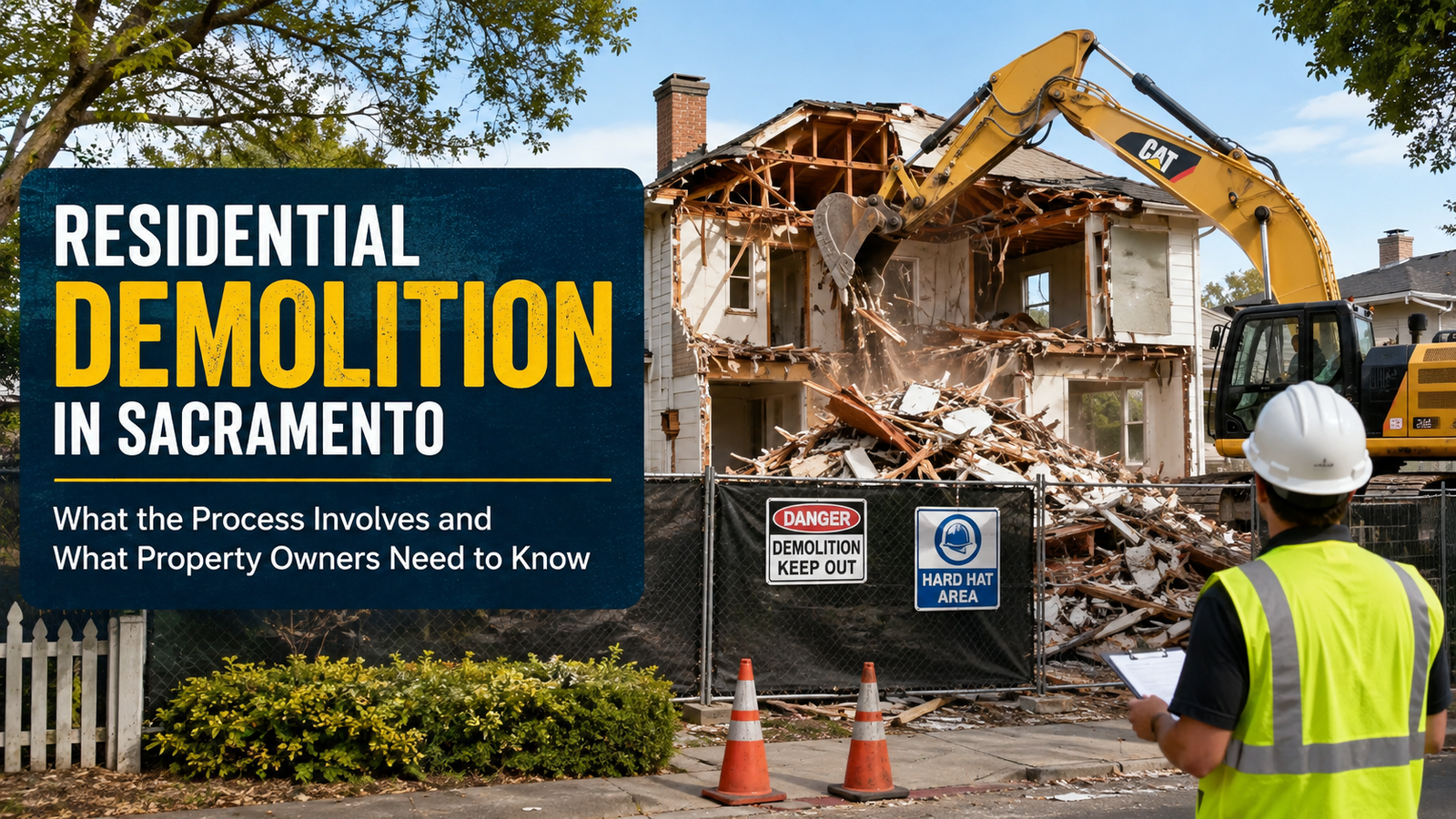
Residential demolition in Sacramento is a service in consistent, year-round demand across the region’s diverse communities from the urban neighborhoods of Midtown and East Sacramento to the suburban tracts of Elk Grove, Rancho Cordova, and Citrus Heights, to the foothill communities of El Dorado and Placer Counties. Whether driven by redevelopment, storm or flood damage, blight elimination, or the need to clear a site for new construction, Residential Demolition Sacramento involves far more than simply knocking a structure down. It is a regulated, sequenced process that requires proper licensing, permits, hazardous material assessment, and systematic debris management. This guide explains what residential demolition in Sacramento involves from start to finish.
Why Residential Demolition Is Needed in Sacramento
Sacramento’s housing stock spans more than a century of construction, and different eras of housing present different demolition scenarios. The region’s post-war suburban expansion produced large quantities of wood-frame homes that are now aging into conditions where renovation is no longer economical. In some cases, structural deterioration from deferred maintenance, termite damage, or foundation issues driven by Sacramento’s expansive clay soils reaches a point where demolition and replacement makes more financial sense than rehabilitation.
Infill development and lot value appreciation have made teardown-and-rebuild increasingly common in Sacramento’s established neighborhoods. As land values in desirable close-in communities like Land Park, Curtis Park, East Sacramento, and the neighborhoods surrounding Midtown have risen, some older homes on well-located lots are purchased specifically for the value of the land beneath them. Demolition is the first step in converting these properties to new, more valuable structures.
Sacramento’s Sacramento County Encampment and Blight Response programs, as well as the City’s nuisance abatement programs, periodically require the demolition of vacant, deteriorated, or unsafe residential structures that have become community liabilities. These program-driven demolitions represent a significant component of residential demolition activity across the region.
California’s Licensing Requirements for Residential Demolition
California requires that contractors performing demolition work hold appropriate licensing through the Contractors State License Board (CSLB). Under California Business and Professions Code Section 7031.5, any person performing demolition work that requires a permit must hold appropriate contractor licensing. The C-21 Building Moving/Demolition specialty contractor license specifically covers the demolition of structures, salvage operations, and house moving. This classification, as defined in California Code of Regulations Title 16, Division 8, Article 3, authorizes contractors to raise, lower, demolish, and remove structures including their foundations.
General contractors holding Class A (General Engineering Contractor) or Class B (General Building Contractor) licenses may also perform demolition as part of their broader scope of work. For projects exceeding $500 in combined labor and materials value which includes virtually all residential demolitions the contractor must be licensed. Property owners can verify contractor license status through the CSLB website at cslb.ca.gov, which shows current license status, classifications, and any disciplinary actions.
The Permit Process for Sacramento Residential Demolition
Under the California Building Standards Code, no structure may be demolished without first obtaining a permit from the appropriate building official. In Sacramento, permit applications for residential demolition are processed through the City of Sacramento’s Development Services Department or, for unincorporated Sacramento County properties, through Sacramento County’s Department of Community Development. The City processes permit applications through its online Accela Citizen Access portal.
The permit timeline for residential demolition in Sacramento typically runs two to four weeks from application submission to permit issuance for standard residential projects. Permit applications require documentation of the proposed scope of work, confirmation of utility disconnections, and for structures that may contain asbestos evidence that an asbestos survey has been conducted. The Sacramento Metropolitan Air Quality Management District (SMAQMD) has jurisdiction over asbestos notification requirements for demolition projects in the Sacramento area.
Older residential structures particularly those built before 1980 may contain asbestos-containing materials including pipe insulation, floor tile, ceiling tile, roofing felt, and joint compound. California’s asbestos regulations require that structures of this type be surveyed by a certified asbestos inspector before demolition begins. If regulated asbestos-containing materials are found, a licensed asbestos abatement contractor must remove and properly dispose of them before the wrecking crew arrives. Lead-based paint, present in most pre-1978 residential structures, also requires specific handling protocols during demolition.
The Residential Demolition Process in Sacramento
Professional residential demolition in Sacramento follows a defined sequence. Utility disconnections precede all physical work Pacific Gas and Electric (PG&E) for gas and electric, the Sacramento Regional County Sanitation District or city utility for water and sewer, and telecommunications providers must all confirm that service is properly disconnected and capped. This step is non-negotiable; energized utilities at a demolition site create life-safety hazards.
With permits secured, hazardous materials addressed, and utilities disconnected, the physical demolition begins. For wood-frame residential construction the dominant building type throughout Sacramento’s residential neighborhoods an excavator is the primary demolition tool. Operators work from the roof downward, systematically breaking apart the framing, walls, and roof structure. The resulting debris is loaded into trucks for transport to recycling and disposal facilities.
Sacramento’s demolition market benefits from an active construction debris recycling infrastructure. Concrete from foundations and flatwork is crushed and processed as recycled concrete aggregate (RCA) at facilities throughout the Sacramento area, where it finds use as road base and fill material. Steel and metal components carry scrap value and are consistently recycled. Wood framing debris may be chipped for biomass fuel or composted. Responsible Sacramento demolition contractors sort and divert material from landfill where possible, aligning with California’s CalGreen construction waste diversion requirements.
Foundation removal follows above-grade demolition when complete site clearance is required. Sacramento’s residential foundations span a range of types: concrete slab-on-grade (most common in post-WWII construction), raised perimeter foundations with crawl space (common in older homes), and in some cases full basement foundations. Foundation concrete is broken with hydraulic breaker attachments on excavators and removed to recycling facilities. The resulting excavation is backfilled with clean, compactable material and compacted in lifts to prevent settlement.
Post-Demolition Site Conditions in Sacramento
The Sacramento area’s expansive clay soils make proper post-demolition site preparation particularly important. Sacramento’s valley soils predominantly Yolo and Tehama series clay loams expand when wet and contract when dry, creating differential movement that affects any surface or structure built on them. Backfill that is not properly compacted will settle unevenly over time, creating depressions that pool water and cause ongoing drainage issues. Professional Sacramento demolition contractors address this by backfilling in compacted lifts and by providing appropriate site grading that directs drainage away from the cleared area.
CalGreen requirements applicable to Sacramento demolition projects mandate that stormwater pollution prevention plans (SWPPPs) be implemented for projects above certain disturbance thresholds, and that erosion control measures protect the disturbed site after demolition is complete. Silt fence, straw wattles, and seeding of exposed soil are standard post-demolition erosion control practices.
Common Questions About Residential Demolition in Sacramento
How long does a residential demolition take in Sacramento? The physical demolition of a typical Sacramento single-family home typically takes one to three days. The complete project timeline including permit acquisition, asbestos survey and abatement if required, utility disconnection coordination, and post-demolition site work typically spans three to six weeks from initial contact to completed site.
Does my Sacramento home need an asbestos survey before demolition? California and SMAQMD regulations require asbestos surveys before demolition of residential structures that may contain asbestos-containing materials. This generally applies to any home built before 1981. Even if you believe your home does not contain asbestos, a licensed inspector’s survey is required to confirm this before demolition can proceed.